

Our Borneo projects
Borneo is where restoration shows its full scale.
Here, we work on restoring degraded rainforest land back into functioning ecosystems, where biodiversity returns, soil recovers, and natural balance is rebuilt over time.
This is long-term ecosystem restoration, where impact is visible not just in theory, but in landscapes that come back to life.

Medicinal plants documentation
The rainforest is a living library.
In Borneo, we document medicinal plant species and their traditional uses. Preserving knowledge that has been built over generations but is increasingly at risk of being lost
.
Working together with the local medicine man and 2 eager young community members, we identify, catalogue, and study plant species, building a growing database of biodiversity and ecological value.
Because protecting a forest also means protecting the knowledge within it.
Palmoil alternatives
Restoring forests also means rethinking what we grow.
In Borneo, we experiment with alternative species that can replace or reduce dependency on conventional palm oil systems. Exploring crops that can be cultivated in balance with biodiversity-rich ecosystems.
This includes testing species combinations, growth patterns, and productivity within regenerating landscapes.
Because the future of restoration is not only about protection, but also about transformation.


Borneo nursery
Every large-scale forest starts with small beginnings.
In our Borneo nursery, we cultivate thousands of native seedlings each year, preparing them for reforestation across degraded landscapes.
Species are selected based on their ecological function, supporting biodiversity, soil recovery, and long-term forest resilience.
From seed to planting, this is where restoration begins.
Forest Monitoring &
Ecosystem Intelligence
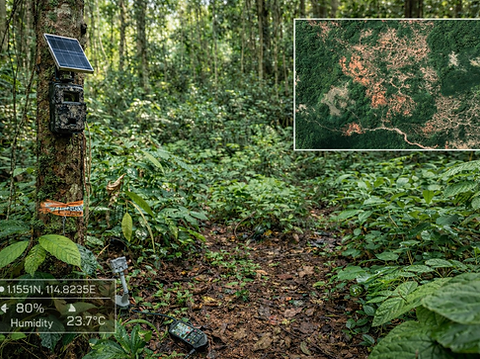
Restoration only works if you understand what is happening.
Across our Borneo sites, we monitor ecosystem recovery through field data, biodiversity tracking, and satellite analysis. Building insights into how landscapes evolve over time.
From vegetation growth to species return and land-use changes, this data helps guide decisions and improve restoration strategies.
Because real impact is not assumed, it is measured.

Reforestation of palm oil plantations
Some landscapes need to be reimagined entirely.
In Borneo, we work on restoring former palm oil plantations back into functioning rainforest ecosystems. Replacing monoculture with biodiversity-rich environments.
This includes reintroducing native species, rebuilding soil systems, and supporting natural regeneration processes.
A transition from extraction to restoration, one hectare at a time.